Chris's Retirement Blog

Saturday, December 1, 2018

Blog #9: Medical Insurance, Retired Words, and Blogging


BLOG #9: Medical Insurance, Retired Words, and Blogging


The things that pop into my mind and make a connection to retiring/being retired are often mind boggling and certainly not anything that would have occurred to me even six months ago. Different things cross my consciousness and some keep on going, some go and come back, and some stick like Gorilla glue and I’m off down a rabbit hole chasing those ideas. What’s stuck with me in the last week or so is health-care insurance, words that have fallen out of use in my personal vocabulary, and the profession of blogging.

BLUE CROSS

The other day I was out at the barn chatting to my barn mate, Bill, who was getting his lovely yellow-dun mare, Sally, ready for a ride in the hay field. (Names changed for privacy.) The day was a beautiful, early-winter day in Alberta with a bright-blue sky that is quintessentially Alberta, a nip in the air, and a skiff of snow on the ground. Just the day for a quiet trail ride (hack for British readers) so that a horse in full winter coat and human bundled up like the Michelin Tyre Man don’t get too hot. I was prep’ing my hubby’s Icelandic gelding, Bear, for a ride as a change from my own horse, Hasty. As Bill’s not normally the chatty type, I enjoyed chatting and getting his perspective on life as a retiree.

Bill’s been retired a few years, he’s a few months older than me, and he was ranting in a quite justifiable way about trying to sort out his Blue Cross medical insurance. When one turns 65, Blue Cross picks up the cost of the premiums and the cost of eye exams, but for those who have more comprehensive insurance plans, it appears to mean an adjustment (of some sort) to those plans. There are probably other things I don’t yet know about, but as I no longer have employer health insurance, and as I have a very basic model of Blue Cross coverage, I was particularly interested in what Bill was upset about. What it boils down to is ageism. Ageism in that, while on the phone to a customer service representative, the explanations (slower and louder) became frustratingly simplified once the rep realized that Bill was 64 y.o. Ummmmmm. Is this what I have to look forward to as I process the paperwork when I turn 65? 

I suggested to Bill that once he’s figured this all out he just explain it to me (without the need for a slower, louder, simpler explanation) so I could save myself the hassle of trying to get information over the phone. 

I have a feeling I’m not done with researching Blue Cross and that this topic will make its way into my daily doings again before too long.

RETIRED WORDS

A “retired”  word popped into my mind the other day probably because our newest rescue kitten (who, as I write, is still looking for a fur-ever home that is somewhere other than my place) was being, well, a kitten. Now, to be sure, Cheddar is absolutely adorable (when he’s asleep), and I love his cheeky confidence and his ambitious desire (or death wise) to engage with our three, mature,  been-there-done-it-not-interested-now female kitties.  I surprised myself by calling him a “silly wee moggie.” If you’ve grown up in England you’re familiar with the term moggie. You’ll know that mog, moggy/moggie, and moggies are perfectly respectable terms of affections for cats.  They certainly aren’t terms I use in Canada (except with those friends who also grew up in England). Unless you are a Canadian with cat-loving friends who grew up in England, the terms aren’t going to register with you. Which got me thinking about other words that I retired from my vocabulary when I moved to Canada but which I drag out of retirement and dust off whenever I’m back in Jolly Olde. 
  • According to Bing, the term Moggy is used for cats that don’t have pedigrees – essentially a Heinz 57 type of kitty (and that’d be most kitties). 
  • According to Merriam-Webster the term Moggy or Moggie was first used in 1911 and the online dictionary suggests that the word might be a diminutive form of Margaret (and M-W would be very wrong). 
  • Dictionary.com (my personal favourite for online dictionaries) says that the noun is an informal British term, puts the first usage much earlier than 1911, and says the term was used to describe a baby cow (well, not in my neck of the woods). Dictionary.com puts first use at 1815-1825 with the possibility of a Cockney origin. 
Either way, the words Mog, Moggie/Moggy, Moggies are retired words and not used in my Canadian vocabulary.  I do think that’s a bit of a shame, and so I’m now on a campaign to experiment with their use in my everyday conversations.

BLOGGING

In case you’re not aware of it, technology hates me. I’m really one of those people who needs a teenager or a 4 y.o. to help me. I gave up using the VCR years ago, and my newish-to-me iphone has many features that are still a complete mystery to me. My computer truly does use its downtime to plot against me and there are more ways that modern technology can thwart me than you can image. So, it’s often something of a surprise to me that I managed at work with multiple programs and databases at SAIT and things technological that were part of my everyday work. It’s also something of a complete surprise to me that I’m even contemplating a “post-retirement career” as a blogger.

The Dummies type books have been a big help to me in terms of setting up this retirement-themed blog, but I’m now moving into the big leagues on self-help books and starting to learn more about blogging so that readers can find me and so that I can make some money out of blog #2.

Blog #2 will be a blog about older gals and their older horses (although it’s not limited to specific types of readers) and my goal is to make money off this blog – something I didn’t know was a possibility until about six months ago.

So, I’m currently reading The Huffington Post Complete Guide to Blogging by too many authors to list. If you want the complete bib info, please let me know. 
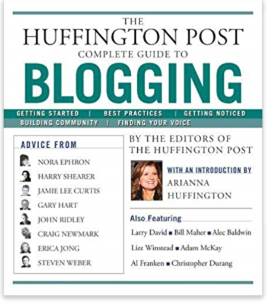

Why I’m mentioning this book is that recently I’ve been chewing on whether or not I’d be happy to make $5.00, $5,000.00, or $50,000.00/ year off blog #2. Where I’ve settled is somewhere between both ends of the financial continuum with the expectation that I’ll be at the lower end.

I also realized (one of those blinding flashes of the obvious moments) that I’m looking forward to putting “Blogger” vs. “Retiree” on the occupation line of my income tax return. There’s a certain satisfaction in having a “real” job title, and I’ll be in the company of some 112 million bloggers world-wide. Perhaps, at some point in the future, there’s an opportunity to put my curriculum specialist hat back on so I can design and develop a continuing education course for wanna-be bloggers.

Here’s a real-fast summary of some information about blogging that comes from the Huffington Post book and that you might not know:

·         According to Technorati, only 36% of blogs are in English; 37% are in Japanese, 8% in Chinese, and 1% in Farsi.

·         54% of bloggers are under 30 y.o. (which means, of course, that I’m in good company as  46% percent of bloggers are older than 30 y.o.!)

·         That there’s an equal distribution of female and male bloggers (yeah!)

·         And that 60% of bloggers are “…less likely to be white . . .”

I was particularly intrigued (and amused) by Item #10 in the Top Ten Reasons Why You Should (blog): “For the opportunity to make an additional $1.65 per week through Google AdWords or the Amazon Associates program.” Well, . . . guess I might be in for a bit surprise then on blog #2.

Professions generally have their own professional organizations. These organizations control membership by qualifications (think degrees and professional designations).  In various ways the organizations also control the behaviours of their members, expect some sort of on-going professional development from members, have means to resolve conflict between members and between members and their clients or governments, and take fees to manage members’ professional lives. Bloggers by their very nature don’t really fit into a “professional” category and, rather like herding cats, would likely refuse to join a professional organization even if one were available. So, now I’m wondering whether or not blogging can legitimately be called a profession. 

Your thoughts?

Herding cats, however, is something I enjoy. Not literally herding cats, but the type of cat herding that, in my recent professional world, was essentially curriculum projects. And in one of those “Let’s leap down a rabbit hole” moments, I’m reminded of that fabulous EDS advert about herding cats: https://youtu.be/Pk7yqlTMvp8


MISCELLANEOUS:

·        When it’s cold and snowy, I can roll over in bed and not worry about driving to work or slipping and sliding down the hill to catch the bus.

·        I applied for a part-time job the other day and realized that if I need to present a resume I have to completely rewrite one as nothing in my current resume is remotely useful.

·        Old-world skills (such as working with horses, riding, driving, etc.) will make me a much-sought-after worker in a post-apocalyptic world when we have no choice but to return to simpler technology. And I can drive a team of horses:  


Medical insurance; old-fashioned, retired words; herding cats; simpler technology; and new professions such as blogging – who’d have thought that retirement could be this exciting!

Cheers, Chris J

Tuesday, November 20, 2018

Blog #8: Transformation, Grief, and Wardrobes


BLOG # 8: Transformation, Grief, and Wardrobes.


I hope, if nothing else, you will give me credit for interesting titles and how I strive to link seemingly disconnected items together and to retirement.


Transformation and grief – the words rather than the feelings – hit my consciousness this last couple of weeks. Wardrobes were an ongoing issue, but they are now resolved.


TRANSFORMATION


This past weekend I was listening to The Sunday Edition on CBC radio. Host  Michael Enright was talking about transformation. In Mr. Enright’s case his personal transformation was around giving up smoking, having children, and switching his metal coat hangers for plastic ones. . . but his point was that however small, transformation is an important process.


Here’s the link to the podcast. Mr. Enright’s musings on transformation start at 0.39: https://tunein.com/podcasts/Current-Affairs/The-Sunday-Edition-(CBC)-p492/?topicId=127128417


One comment in particular struck me and it has stuck with me: “If you want things to stay the same, then things are going to have to change.”  Mr. Enright said that he loved the idea behind the quote but that he had no idea what it meant. I’m with Mr. Enright on this one. In some ways, the meaning is perfectly obvious, but I suspect that that obviousness is hiding a deeper meaning that is currently eluding me. And, I suspect this may cause me to leap down yet another rabbit hole to chase a bunny who may or may not be there.


I am now five months into this semi-retirement thing, and I am beginning to think I am getting the hang of being a retiree. . . and there is certainly a lot of personal transformation going on. I don’t know if I am just overthinking this whole thing (a distinct possibility), or if I just didn’t prepare well enough for the emotional side of retirement, or if my decision to retire a couple of years earlier than planned is a contributing factor. I do know that the transformation from fully employed worker in a professional field to unemployed person in no field has been a tad rocky.


GRIEF


Grief is part of life, of course, and often leads to transformations. The recent death of a friend’s beloved horse got me thinking about grief in different terms.  And the term “grief” has recently forced its way into my thinking as I have come to realize that for a while I grieved the loss of my employment, my profession, my place in the working world. I had expected some grief, but I was surprised by the depth of that grief. Somehow, naming it gives me some control over it. I think I’m largely over that now – thank heavens-- but what a relief to have figured out why I was having such a rough journey for the first couple of months.


I had coffee last week with a  former SAIT colleague and she mentioned that only now, two years into retirement, is she thinking of herself as a retired person.


WARDROBE


You may recall my dithering around what to wear to the Charlotte Dejardin clinic way back in the summer and my ongoing musings about retirement clothing. For the Charlotte clinic, I settled on a crisply-pressed pair of jeans and lipstick because the clinic was in the Calgary area and there is not a problem in the world that cannot be fixed by the right shade of lipstick (or a nice cuppa tea . . . depending on the circumstances). That decision should have put me on the right road to the solution for my retirement wardrobe and would have saved me a couple more months of dithering if I had only paid more attention.


To be fair, you’d be hard-pressed to put Chris and sartorial splendor, fashion forward, or fashionista in the same sentence, but  clothes do maketh the woman, and it is important that the clothes match my new “job” as a retiree.


I am, quite frankly, amazed at how much energy I have been devoting to my worries about my retirement wardrobe. The last time I concerned myself with a wardrobe of any kind was back in the, oh, early ‘80s when John T. Molloy published his The Woman’s Dress for Success Book. I’ll bet I still have a copy tucked away in one of the many piles of books in one of the rooms of my home. I’ll bet that several of my friends also have copies tucked away somewhere. Back in the 1980s women were taking the business world by storm and were straddling the line between what might be seen as traditional women’s clothing and the female version of the male business suit. Mr. Molloy’s book hit North America by storm. Those of us then-young women struggling to make our way in the business world (not yet aware of the “glass ceiling”) were intrigued. I know I was . . . and not so much by the advice but the research that went into that advice. I’ve never been able to look at how people dress in the business world quite the same way ever since.


If you’re old enough to vaguely remember this book but can’t recall it, maybe this image will jog your memory:


Long before Mr. Molloy’s research and recommendations made their way back into my memories, I had started conducting my own informal survey of a few women friends to see if they had any advice for me. Informal as in not in the least scientific: no hypothesis, no well-thought-out testing, no defensible evidence.


Why is this “research” important?


Here's why: Chances are, in your retirement planning, you have given absolutely no thought whatsoever to your retirement wardrobe. You’ve taken care of your pension and your investments; you have taken care of your post-retirement career or activities; you may even have planned the trips you want to make before ill health and lameness rob you of the opportunities, but I’m just betting that you have never, ever given any thought to what sort of wardrobe you need to be a smartly-turned out retiree. 

So please take my struggles as my gift to you.


My women friends come from an education, a nursing, an equine, and an oil industry background. What follows is a summary of their comments (names removed to protect the innocent) . . .


“ It’s been a challenge to figure that stuff out!  . . .  there really was not a great deal of middle ground between my old office wardrobe and my babysitting/cleaning/gardening apparel. . . it actually took me a very long time to transition my wardrobe.  Initially, I had thought I’d keep everything that I used to wear to the office in the event I might go back.  When I shopped I would naturally gravitate to that look, too.  That really didn’t work. . . it’s now evolved to my wearing jeans of some form or another most of the time, even to a dressy event where I’ll put a better pair with a nice top or jacket and nice shoes.  .  I like scarves and good jewelry to dress things up.  I think with a big change like retirement we initially spend a lot of time thinking about how we’re presenting ourselves to the world because it’s so different from what we’re used to.  It takes some getting used to - I don’t think it can be rushed.”


“ I didn't need to buy a new wardrobe because my work clothes were pretty casual. I can get away with my work clothes any time I need something other than jeans which isn't very often. I do have some 'lady clothes' full length black skirt, matching trousers, and a couple of drapy tops. I have a pair of patent leather flats and a pair of Mary Janes to complete the ensemble. On the rare occasion when something semi-formal is expected I can get away with some combination of those which I dress up with a collection of infinity and regular scarves and pins.”


“An interesting question - one that another friend of mine and I have been discussing as she transitions into her "life of leisure." The hardest part I have found (and still have troubles with) is that I keep looking at clothes and think "that would make a good office jacket." Before retirement, I did have three types of clothes: office clothes, chore clothes and dress up clothes. I've recently decided that I'm not going to keep the "dressy casual" stuff in the closet on hangers. Now, unless I'm doing a "crud" job, I try to wear something a little nicer than I would have previously. I'm gradually getting rid of the office attire (thrift store, consignment) and keeping only those blazers that I really, really will wear to say a meeting, jury duty, etc. I've found this to be one of the harder phases of retirement - what a curious thought??? I wonder what Freud would think about this???”


One friend used the term “Elevated Casual” which I think is absolutely perfect for this transitional wardrobe as I transform from an office worker to a retiree.


There is some relief in knowing that I am not the only person who has struggled with this part of the transformation, and the question that I had previously consigned to the frivolous box is actually an important step in the transformation process.


. . . and then I had an epithany, or perhaps I really mean a blinding flash of the obvious.


I live in Calgary, and providing one has a good pair of nicely-pressed jeans, one can go pretty much anywhere. The bridge between my workplace wardrobe (many pieces I still have) and my barn wardrobe is so obvious: denim.


Jeans I already have: one pair of “Mom” jeans and one pair of skinny jeans. Somewhere I have a denim skirt.  I have a couple of denim shirts: one that is downright scruffy and fit only for the barn but the others that are quite smart if pressed. I was recently successful in my  hunt for a denim jacket. So that only leaves the search for a denim dress – and I’ll probably have to wait till a couple of weeks before Stampede for that item.  Everything else I own from multiple versions of black t-shirts to jewellery to shoes fits around the denim theme.


You have no idea how relieved I am!


So,  my wardrobe woes are all resolved and you’re unlikely to hear any more about it.


MISCELLANEOUS:


On my recent trip to the U.K. I learnt that “concessions” (seniors’ discounts) are not available on rail travel unless one has a rail card (which means one has to be a resident), the concession on entrance to Conwy Castle in Wales is a whopping 70p, and the concession on the hop-on-hop-off bus in Glasgow is a whopping One Pound. This is not enough to buy a cup of coffee . . . with the singular exception of Pret a Manger which has a decently-sized cup of coffee for 99p.


A friend of mine was talking about a movement in the U.K. where more and more folks are refusing to identify with their ages because they don’t feel their ages. She also suggested that the term Old Age Pensioner (OAP) be consigned to the bonfire! Good suggestion! . . . Let’s also dump the terms Seniors’ Discount and Golden Years to that same bonfire.


Grief and transformation are often connected to each other even if we don’t realize it at the time. Acknowledging both states of being and incorporating those words into how I see myself as a retiree are as important as resolving my wardrobe woes.


Or, perhaps, I really am just over thinking everything.

Friday, September 21, 2018

Blog #7: Women's Titles, Jury Duty, Precarious Employment, and Penis Envy (again)


BLOG #7: Women’s Titles, Jury Duty, Precarious Employment, and Penis Envy (again)


Today, September 21, marks three months since I left SAIT and semi-retired. I have to admit that I am still processing how I feel about moving from being a fully employed person to an unemployed person (because being retired is being unemployed in the traditional sense). I still feel as though I am on a long vacation, and I expect that won’t change until I return from England at the end of October.


WOMEN’s TITLES


A couple of weeks ago I was on 17 Avenue SW meeting a group of fabulous women for brunch. This was the height of summer so pretty summer dresses and sandals, shorts, muscle shirts were normal attire for most folks at this point and it was blisteringly hot by 10:00.  I  was arriving at a rather upscale establishment, and I was the first to arrive. The doorperson greeted me and called me Ma’am. Thereafter, however, the wait staff called me Miss.


Put aside traditional titles for woman with respect to their marital status (and this assumes they aren’t using a professional title such as doctor or reverend/pastor/rabbi, etc.). I don’t wear a wedding band so there’s no traditional and obvious clue to my marital status, and I use “Miss” rather than “Ms” as my title, but I got to wondering at what point does a woman change from a Miss to a Ma’am or Madam? For example, what clues are there for people that one might call a 22 year old woman “Miss,” but refer to that same 22 year old woman pushing a stroller as “Ma’am”?


Were the wait staff trying to be polite to an obviously matronly woman thinking calling me “Miss” would make me feel better?


What’s going on?


You’ll notice that men don’t ever change their titles.


Perhaps we need a new title for retired persons who are female. Open to suggestions on this one.


JURY DUTY (and ageism)


Discrimination takes many shapes and forms and ageism is just one of those forms . . . and the latest example for me is to discover that I become exempt from jury duty once I turn 65. Why? Does my brain suddenly atrophy at 65? Why at 64 am I considered capable but suddenly at 65 I am not.


I’m pondering on this piece of information because  I recently received a summons for jury duty, and if I’m called to be assessed for jury duty, I’m not sure if I should work hard to demonstrate that I am cognitively and physically capable of performing my civic duty or if I should just let bias have its way and use this as a get-out-of-jail-free card (pun intended) so I can avoid jury duty.


PRECARIOUS EMPLOYMENT:


I’ve been thinking a lot recently about how my reentry into the workforce will take place and in what format it’ll be. Coffee with a friend really got me thinking about minimum wage (in Alberta this goes up to $15/hour this October) and what type of work I want to do. My friend mentioned that she didn’t think she could/would work for minimum wage. I have to ask myself, “Would I?”


The term “precarious employment” has entered our lexicon in the last few years.


In terms of precarious employment, I have my daughter’s mid-twenties  friends and coworkers to gauge by, so my observations are hardly scientific. What I observe is that very few of them have been or are currently enrolled in post-secondary courses/programs that would lead to professional positions and that most are under employed, employed part-time, or  employed part-time and working two or more jobs. This is not a criticism of their life choices, merely an observation and a convenient platform into observations about employment. Leap back about 25 years and long before the term “precarious employment” was coined, and I was working as a part-time contract instructor. Now, it’s a sad fact that many post-secondary instructors/professors start out their careers as casual or sessional instructors. This is also the time when these folks are establishing their careers, paying back student loans, possibly looking at settling down (think mortgage, partner, children).  It’s also a sad fact that for budget management reasons many institutions take advantage of this group of folks. I know, I was there for seven years . . . although, to be fair, I also had a baby/toddler at the time and working part-time somewhat worked to my advantage. But looking back on this experience I realize that apart from these seven years of very iffy employment, most of my work has been full-time work that included a decent salary, employer benefits, and a pension plan, and those features definitely lift a job out of the realm of precarious employment.


So, here I am on a short-term contract working part-time as a provincial enumerator for minimum wage. I’m enjoying the work, actually. I can tell you that your provincial government is working very hard on your behalf to ensure that you can exercise your right to vote. This contract provides me with a purpose for my daily walking, I get to work by myself with not a committee in sight,  I’m getting to know a part of Calgary I didn’t know existed except in passing,  and the money I earn will pay for the plants in my new Chinook-hardy flower garden. On one side of my zone are multi-million dollar homes with gorgeous front gardens and high-end vehicles parked on the streets and up the driveways . . . and on the other side of my zone are dwellings where the occupants are clearly struggling financially and the vehicles are what one might refer to as beaten up bangers. No judgement on my part (I hope) . . . sometimes it takes a while to establish oneself and one must live the way one needs to in order to make ends meet. But I couldn’t help reflecting that many of the folks on the “wrong side of the road” are probably precariously employed and also that if I weren’t retired how I, too, would qualify as being precariously employed. I’ve also been chewing on how many hours at minimum wage it’s going to take me to earn around $450.00 (around 30 hours) and how quickly I could have earned $450.00 working in education.


This knowledge won’t stop me from taking on other short-term, minimum wage positions if they interest me because there is at least one big advantage: limited responsibility . . . limited responsibility from me around organization and planning vs. actually doing of the job.


And I’ve been chewing on this new knowledge a lot recently. Not that I’ve arrived at any logical answer, but the chewing in itself is interesting as I’m having to confront a whole bunch of assumptions about the value of work, value of a profession, value we as a society place on different professions. And having the opportunity to walk around two very different communities divided only by one road has got me thinking about life choices, access to opportunities, taking advantage of opportunities, expectations of oneself, what career decisions I might have made if I hadn’t made my way into education. And I’m beginning to wonder if my return to work will be back into education (either teaching or curriculum work) or whether or not it will take some totally unexpected shape that I haven’t even considered.


PENIS ENVY (again):


September in Calgary has seen below average temperatures  and some snow (anything from a skiff to a dump depending where in the province one lives). Our normal daytime temperatures this time of year are around +15C to +18C . . . not hovering around zero. September has really been the month that didn’t happen. This follows a blisteringly hot and incredibly dry summer and weeks of forest fire smoke from British Columbia limiting outdoor activities.


This abrupt change in weather and temperatures has proved difficult for the horses who are in the process of changing coats . . . which means they are still shedding their summer coats and have grown only the start of their fall coats (which, by November will be heavier winter coats).


What does this have to do with penis envy? . . . hang in there, I’ll get to it.


So, horses who are not normally rugged at this time of year are already in rugs or at least wearing rugs till the weather normalizes, and horsey humans are dragging out every piece of barn clothing so they can stay warm when working with their equid buddies.


In addition, in my work as a provincial enumerator till the end of September,  I’m bundled up like the Michelin Tyre man as I complete my routes.


All of which has got me looking for my long johns, Stanfords, woolly combinations – whatever you choose to call them.


Are you starting to see the connection?


So, woolly combinations for men: often all one piece so the waist band area never gets cold . . . possibly with a bum flap for more serious stuff, but still minimizing exposure to the cold . . . and a fly to, again, ummmm minimize exposure to the cold.


Check out the union suits (a new term for me) from the LLBean catalogue https://www.llbean.com/llb/shop/47356?page=two-layer-union-suit-men-s&bc=12-26&feat=Long%20Underwear-SR0&csp=f&searchTerm=Long%20Underwear (and a word of caution: if you are going looking for woolly combinations online, please be careful just which website you select to look at!!!!!). 


Women’s combinations: ummmmm, well, unless a woman wants to divest herself of snow suit equipment, several woolly sweaters and such, a one-piece combination would require that she completely undresses in order to pee and that means maximum exposure to the cold. Which is probably why women have two-piece combinations . . . but there’s still a lot of skin exposed just to take a whiz. And let’s not forget that younger women are often managing small children (also wearing multiple layers of clothing) in public bathrooms, so that adds another layer of complication.


Gentlemen, once again . . . please realize just how lucky you are. . . and please give some thought to your horsey women friends as we manage our combinations.


And on a side note, have you ever noticed that no character in a novel ever has to visit the facilities? Recently I was reading a futuristic novel (and like all futuristic novels it was depressing, bleak, and not at all positive), and the protagonist had to pee, outside, in the forest, and she was worried about privacy and getting her boots wet (refer back to Blog #6 if you don’t get the reference). I wish I’d noted the exact paragraph and the protagonist’s comments. Good job she wasn’t also coping with her woolly combinations.


MISCELLANEOUS


Recently I was watching one of Rick Steves’s travel programs. This was part of PBS’s drive for viewer funding, and Mr. Steves mentioned that his travels abroad to exotic countries were, in some ways, safer than staying at home. Tactful, careful, and mindful of his audience, Mr. Steves’s comments were still pointedly obvious (he is American) and his feelings about his current government were all the more powerful for his tactful, understated comments. I will keep his comments about the safety of travelling abroad in mind as I shall shortly be packing for a month-long stay in the British Isles.


Even though I don’t have my birth year plugged into my Facebook profile, its algorithm (?) must be picking up on comments about retirement because a lot of the pop-up adverts are to do with things of interest to retired persons. This got me thinking about a book I recently picked up at the library. I tried (unsuccessfully, again) to read a book by Catharina Ingelman-Sundberg. This one is called The Little Old Lady Behaving Badly, and it’s translated into English from Swedish. I love the title! Despite loving the concept of a gang of old folks plotting to and then successfully robbing banks to support their charitable endeavours, I’ve not been able to get into the two books I’ve tried reading. Not that I’m considering a post-retirement move to a life of crime, but I do love the concept of elderly folks behaving badly.


I’ve been spending rather a lot of time at SAIT recently  dropping off or picking up my currently carless daughter from her photography courses. Somehow, in the last three months, I have managed to completely disconnect myself from campus and I feel no more than I would feel moving around Mount Royal University’s or University of Calgary’s campuses. Which is a tad odd because I’ve spent so much time and so many years on campus. Next week, I’m on campus visiting and lunching, so it’ll be interesting to see if I feel any different or if I feel like an outsider? Odd that a place that took up some much of my emotional and intellectual energy now neither takes anything from me nor gives anything to me.


. . . and in the category of things I can now do:


1.      Popping out to the barn for an appointment with the farrier (blacksmith) on a weekday without booking a flex day or vacation day or negotiating with a barn buddy to bring the horses in for me.

2.      Running out to a hardware store during the quieter weekday hours (in this particular case shopping for some wood).

3.      Rolling over in bed and going back to sleep because it’s still dark/cold/wet/miserable out. Now if I could only train my Canadian husband and Canadian daughter that the British idea of bringing mum tea in bed is acceptable in Canada.

4.      Playing Mum’s Taxi Service without having to negotiate days off work or juggling work commitments because my daughter Heather was recently involved in a traffic incident. She’s okay (we’re still not sure about her car, though), but having one parental unit to drive her around to various medical appointments is a big bonus and clearly a bonus linked of my being semi-retired.


How did we move so very quickly from hot, sunny, long summer days of summer dresses and sandals to the cold, crisp, short fall (autumn) days where I’m thinking of woolly combinations? Is there a parallel here between moving from being a full-employed professional to a semi-retired/ unemployed person and moving from summer to fall?

Friday, August 10, 2018

Blog #6: Loss, Penis Envy, Seniors' Meals, Statistics, and More on What Retirement Means


BLOG #6: Loss, Penis Envy, Seniors’ Meals, Statistics, and More on What Retirement Means


What does loss, penis envy, seniors’ meals, and statistics have to do with retirement? Bit of a stretch, isn’t it?, but these are the things I’m mulling on these days. . . plus more chewing on what retirement does actually mean and entail.


LOSS


In the week leading up to retiring from SAIT I had an opportunity to attend a one-hour workshop on preparing for retirement. Not a financial workshop but more of a personal wellbeing workshop. Could be too little too late, but I had already been giving a lot of thought to what my retirement would look like in the immediate, medium-term, and far-off future. I recall only two things from the workshop: finding something that provides one with value to oneself and a person’s 60s being the decade of loss.


Yikes!


And yet, the decade of loss is a reasonable statement. Depending on how closely a person is tied to his/her profession/trade, there is the loss of employment, loss of profession/trade, loss of career identify, loss of status in one’s professional community, loss of salary, loss of benefits, loss of routine,  loss of like-minded buddies, loss of interesting and meaningful work, and probably other losses connected to employment I haven’t considered. If one has parents still alive, they are elderly, and a person can expect to lose them in her 60s. Friends are no longer dying in stupid, youth-related, ill-advised, devil-may-care accidents but of age-related illnesses and diseases. Those lucky enough to have grandchildren might be seeing the eldest of those children preparing to leave home and head off to college/university or jobs away from home.


All of which is a little depressing . . . and looks at retirement from a somewhat negative viewpoint. Because I’m doing Google-type research on retirement (for ideas related to a money-making blog at some distant time in the future), these types of articles are popping up: “Don’t retire,” “No Need to Ever Retire,” “Retiring is the Worst Decision You’ll Ever Make.”


What really brought loss home to me this past couple of weeks was the illness and the death of  fellow horse woman Cathie. Cathie was a lovely woman and more of an acquaintance than a friend. However, our mutual interest kept our paths crossing for about 30 years, she was only 55 y.o., and while she’d lived a good and full life, Cathie’s plans for herself would undoubtedly have included another thirty good, horsey years.


PENIS ENVY


If you’re wondering how on earth I’m going to tie the male member into retirement, you’re not alone, but I believe I can do it.


And if you’re worried I’m about to launch into a feminist diatribe, well, no . . . at least not this time.


What starting this particular trip down this particular rabbit hole was a comment posted by a buddy on FB and a recent volunteer stint at a horse show. Just to be clear, the two events aren’t related to each other.


The FB comment first:


To protect the innocent, names withheld . . . but my buddy and his 85 y.o. mum were talking about censorship in art and her reply was, “Well, at least fig leaves are more attractive than most penises.” Not a conversation I’m likely to have with my 86 y.o. mum. I have to wonder just how many penises this mum has seen that she can confidently make this statement. And . . .  I can’t help thinking that  if most of the female of the species felt that way, the human race would have died out a long time ago. However, go Mum go and keep making these types of comments, please.


The horse show:


I had an opportunity to work with Faye timing the speed event at the Working Equitation sanctioned show in Cochrane on a blisteringly hot Sunday. Working Equitation is very popular in Europe and is somewhat similar to western trail events if you are familiar with those. There were two events at the Cochrane Ag Centre that weekend: the Working Equitation show and the Extreme Cowboy show. Couple of hundred people between the two shows (spectators and competitors not counting horses and dogs). . . two port-a-potties (as in just two potties). . . four days of competition
 . . . four days of blisteringly hot heat beating down on the potties. . . did I mention the couple of hundred humans? . . .  and I’m guessing at this point you can see where I’m heading.


Nope, nope, nope. Not me. Not using those port-a-potties. Nope. But in that heat. I needed to stay hydrated, but drinking a lot of water leads to . . . well, the necessity to make trips to the loo. Contemplating the port-a-potties was a non-event and . . . well, this is when horse stalls start to look like attractive alternatives without or without the horse for company. But . . . modesty is an issue for girls.  The ancient knees of retired gals are also a bit of an issue: creaky and not terribly reliable about raising us back up to standing . And then that the ever-present concern that all gals have about peeing on their boots. So, “Suck it up, Buttercup” takes on a whole new meaning . . . and that’s where penis envy comes into the conversation.


Forget all about male privilege, what I envy is the very practical ability men have to pee outside without fear getting their boots wet, without exposing too much of themselves and risking a loss of modesty, and being able to pop into a horse stall to pee without having to bend their knees to accomplish the task.


Gentlemen, you have no idea how fortunate you are. Think about this, please, next time you are somewhere with large crowds and few port-a-potties.


SENIORS’ MEALS


Why are senior’s meals half the size of regular meals?


Why does the Seniors’ Menu offer only a very limited choice of meals?


Why do only family-style restaurants (think Smitty’s, Denny’s, Humpy’s, etc.) offer seniors’ meals but more upmarket dining establishment do not?


And something I’ve never thought to ask is whether a seniors’ discount is still applied to a reduced-size meal.


Not that it matters as there’s seldom anything of interest to this vegetarian diner, but I do wonder why the menu is so limited. If you know, please enlighten me.


STATISTICS


For someone as math phobic as me, it surprises me that I like statistics. When I check my blog site I see that most of my readers are located in Canada and England, I can find out how many hits my blog has had each month, and I can even find out what type of device was used to connect. What I don’t know is quite what I’m going to do with this information. I sense a little more research is in my future.


MORE ON WHAT RETIREMENT MEANS


Earlier, I talked about loss, and that’s something I’ve been chewing on quite a lot recently (with respect to retirement). I’ve mentioned that I’m unlikely to be a successful fully-retired person. What I am not missing is the politics, the panics, the projects that go seriously sideways. What I am missing is the intellectual stimulation, planning interesting projects, taking those projects to completion, wrestling with problems and solving them, working with like-minded folks, joshing around with colleagues, working as a well-oiled cog in an efficient machine.


Shortly before I left SAIT, Diane sent me a link to a short article about a book by Jonatan Chevreau called  The Four Phases of Retirement.


Quick summary here:


·         Phase 1: typically freedom from obligations and vacation mode

·         Phase 2: the “… abyss of insignificance” and losses to do with one’s place in the working world and one’s profession

·         Phase 3: Response to those losses/trial and error and the realization that time’s running out and one needs to get cracking to accomplish what one wants to accomplish

·         Phase 4: Reinvent and Repurpose


As I’m just about to enter week 8 of semi-retirement (I’m really thinking of this as a sabbatical) . . . I am clearly still in Phase 1 and expect to stay there for a while, but I already see signs of Phases 2, 3, & 4 creeping into my thoughts.


Several women friends have recently retired. Some have successfully fully retired, although I doubt if they drop entirely being teachers, medical folks, artists, horse trainers, librarians, etc. These folks seem to have embraced retirement, devoted themselves to established hobbies they didn’t quite have time to do while working, or picked up new interests. Some others retired and then promptly reinvented themselves in new, post-retirement professions. So, there’s a certain amount of retirement-related envy on my part as I’ve not become comfortable with being retired and I also have not figured out what my new post-retirement career will look like.


Stay tuned on this one as I expect there’ll be a lot of chewing on this topic in the short- and medium-term of my retirement.


MISCELLANEOUS:


In the category of “Things I can now do . . .”


1.       Going for breakfast on a Friday morning with a friend.

2.       Going out for dinner on a week night, staying out late (because I can) as I don’t have to worry about getting to bed early so I can get up at 05:30 the next morning.

3.       Forgetting that a long weekend is coming up.

4.       Going out for lunch on a Tuesday with Joan.

5.       Being out at the barn for 08:00 on a weekday so I can work two horses before it gets too hot.

6.       Pushing aside all thoughts and minor panics about preparing for fall startup.


AND . . .


Did I do it?


Did I manage to link loss, penis envy, seniors’ meals, and what retirement means to retirement?

Sunday, July 29, 2018

BLOG #5: Horses, Reading/Writing, and Blogging


BLOG #5: Horses, Reading/Writing, and Blogging


Not much has got done in the last five weeks. By now, the basement was to have been sorted out, the living room rearranged,  the garage tidied up, and the rough work in the back garden completed. I blame my lack of productivity on my busy social life, my time spent out at the barn with the horses, my willingness to jump in a car and go off on a road trip on short notice, and the catching up with friends.


Now that my mind isn’t chewing on work-related problems or solutions to projects, it’s free to meander and wander and make weird connections and so the connection between horses, reading/writing, blogging, and retirement is obvious to me and, I hope, it will become obvious to you.


HORSES


I’ve been a horse woman for, ummmm, maybe 60 years give or take a year. I’m not sure when I began my love affair with horses, but it may have started with the piebald cobs that pulled the rag-and-bone men’s carts around the neighbourhood. Yes, I am that old and yes, we still had some horse-drawn transportation back in the day. Those piebald/skewbald/pinto cobs were just Heinz 57s back in the day. Now they have pedigrees and go by the name of Gypsy Vanners. Then and now they were/are lovely critters.


Regardless of the equid’s breed, unless you grew up in Northern England and are of a similar vintage to me, I’m betting you have not a clue what a rag-and-bone man was? Think recycling. If you’d like to have a little bit of information on English history, check out this link: https://en.wikipedia.org/wiki/Rag-and-bone_man and check out the lovely horse in the bottom right image. Rag-and-bone men and their horses were an everyday occurrence back in 1950s/1960s northern England. But where I first got a taste of riding equids can only have been on the donkeys on either the Blackpool sands or the Morecombe sands. https://www.bing.com/videos/search?q=blackpool+beaach+and+donkey+rides&view=detail&mid=14EAA687F4B27CDCDD7A14EAA687F4B27CDCDD7A&FORM=VIRE. A hard life for the donkeys, but great fun for kids.


The love affair began and continues.


A week or so ago I was at the Charlotte Dujardin clinic at Rocky Mountain Show Jumping (Anderson’s place just south of Spruce Meadows). I reminded myself that even though I couldn’t achieve that level of riding with my current horse (or any horse for that matter), I could still enjoy dressage at my level, and I find that I am now (finally)  content to be what the Brits call a Happy Hacker (aka trail rider).


The clinic was marvellous. Charlotte is a great instructor with an excellent eye for small details and small tweaks that make a big difference in performance. I aspire to be that kind of teacher when or if I find myself back in a classroom (face-to-face or online). I was also impressed with Charlotte’s ability to talk non-stop for about six hours . . . and I enjoyed her British humour and sarcasm (which I can only assume she toned down for her Canadian audience). There were a few ladies-who-lunched in the 99% female audience, but most were horsey folks who had shown up looking like horsey Calgarians. Remember my concerns about how to dress for this event and settling on well-creased jeans and lipstick? I needn’t have worried and most folks were in jeans (and many crumpled rather than deliberately creased).


Attending clinics such as Charlotte’s and watching young women coming up through the ranks in their sports reminded me that I have not always felt so confident and comfortable with my acceptance of being a recreational rider. There have been many times when I have seriously questioned what the heck I am doing having any aspirations around riding and working with horses. Many of those times involve nasty tumbles and ending up in hospital, but two times do stand out. When I was 21, in Vienna, Austria, I watching the Spanish Riding School horses perform and I was ready to just give up because I’d never be able to work with a horse at that level (https://en.wikipedia.org/wiki/Spanish_Riding_School). Another time I was around 25 y.o. in the Sydney, Australia, area riding in the Outback and I watched a cowboy gallop his horse down a steep incline. Nope. Not me – and I thought I knew how to ride. Think that iconic scene from The Man from Snowy River where the dashingly-handsome cowboy rides his lovely dun horse down the mountain side (https://www.bing.com/videos/search?q=the+man+from+snowy+river+with+poem+and+music&view=detail&mid=4B17184615BF031076894B17184615BF03107689&FORM=VIRE – just watch from 2:39 to 3:09).


And the connection to retirement? I now have the leisure to ride during the week rather than trying to cram all my horsey stuff into the weekend because, well, I was always too pooped after work to drive out to Cochrane. Many of the folks at the barn are retired and so there’s always someone to hang out with and ride with. Hasty is now a well-seasoned 24 y.o.; and although our first eight years were a bit rocky,  we’ve now been together about 16 years so we know each other very well and work together very well.


And so while Hasty’s more mellow than he was as a youngster, he is also 24 and getting just a little stiff. Just as I’ve moved into semi-retirement from paid work, Hasty’s moving into semi-retirement as a riding horse. . . and so more of my efforts can go into my hubby’s (David Thompson) young Icelandic gelding, Bear.


READING/WRITING


Just as I’ve always been a horse woman, I’ve always been a writer. Not that I think for one moment that I have the Great Canadian Novel in me, but I do think there are writings yet to emerge from me that may delight, entertain, inform. And not that business writing isn’t creative – drafting and honing proposals, reports, and workplace memos is indeed a creative process. Now that the stress of being in the paid workforce is leaving my mind and my body I find I have the energy to think creatively and to write. I am delighted to discover that I still have a desire to write especially as I thought I’d lost that desire completely. My scribble book of ideas is being well scribbled . . . so who knows where that will take me.


I’m hatching ideas for a children’s book (horse related, naturally) – and this is something I would not  have had the intellectual energy to consider even five weeks ago. So, I’m right on target, right? Don’t many retirees say they want to write?


And reading? Well, two to four books/week depending on how busy I was at work and whether or not I was on vacation . . . plus at least one horse magazine and at least one technical document usually related to teaching or curriculum design. The more one reads, I find, the better one writes. One can learn from other writers about how to elegantly craft sentences, cleverly manipulate meaning through carefully placed punctuation, evoking emotion though carefully places words and phrases and images. It helps, too, I find, to move out of one’s favourite genre (for me that mystery novels) and into other areas. S.t.r.e.t.c.h.i.n.g. one’s ideas. I was ruminating on the connection between reading and writing this morning as I was sipping my tea on the kitchen deck. Of course, reading may also be a contributing factor to none of the housework and reorganization getting done.


BLOGGING


Remember that technology basically hates me. To borrow an expression from a  friend, I am a techno peasant (or digital immigrant if you want a more official term). My computer spends its down time plotting how to thwart and frustrate me (seriously). Until a couple of weeks ago, what I knew about blogging could fit on the head of a pin with plenty of room to spare. But with my niece Katherine and friend Marian as my guides, I managed to get started. If you sense a rabbit hole coming up, you’d be right. Now I want to figure out at least one more blog and I want to figure out how to make money from that one. Apparently it’s possible (who knew!?) Thank heavens for the library and the Dummies series of help books because they are my guides on this venture. Thanks to Dummies, I've now learnt how to add photographs.

My growing knowledge, which is easy to grow when one starts from zero, is leading to all sorts of ideas popping up. The connection to retirement? Well, I think there’s one blog about retired gals and their geriatric horses in the making.


Miscellaneous:


Added to the ever-growing list of things I can do as a retiree is going off on all-day field trips midweek. The latest one was to Rowley (a ghost town near Drumheller, Albert), where I met the delightfully chatty 10 y.o. Jesse who happens to be the great, great, grandson of the original owner of the livery barn. Well worth the trip, especially if one is a photographer. Cross country (a very pleasant trip this time of year) about 2.5 – 3.0 hours from west Calgary. https://www.bing.com/images/search?q=rowley%2c+alberta&qpvt=rowley%2c+alberta&FORM=IGRE


Remember I said that I’m unlikely to be successful as a fully retired person? Well, I applied for a job as an enumerator with the government. Stay tuned on that one. And I’ve been invited to co-author a couple of education-related articles . . . so it would seem that work and I aren’t quite done with each other yet.


I just finished reading a novel set in 1901 Edinburgh and, for no reason I’m aware of, an old expression popped into my mind: “You’ll be right as nine pence.” Which caused me to wonder what is so magical about nine pence (this is in the old British currency) and what was the problem with eight pence and ten pence. Any ideas? . . . and as for me, I’m right as nine pence myself and off to be a gopher at the Working Equitation show this weekend in Cochrane. J

Friday, July 20, 2018

BLOG #4: Retire/ment, and Napping and . . . a few things I don't need to do


BLOG #4: Retire/ment, and Napping and . . . a few things I don’t need to do


I’m now our weeks into this new state of being, I know now that I am likely to be a complete flop at being fully retired.


True, I now understand why retirees say, “I’m so busy I don’t know how I had time to work.” I am busy, and I am booking coffee dates and such a good three weeks out in my calendar. There’s still a lot of work to do in the yard (planting a prairie garden in the backyard and re-sodding the front yard) and in the house (wrestling out-of-control rooms back into submission). I’ve come to realize that my retirement certainly won’t be my grandmothers’ retirement and won’t be my mum’s retirement either. . . and that got me thinking about what do we mean, in 2018, when we say retirement.


RETIRE/MENT:


Do we need another name for this phase of life? I think so.

Dictionary.com (one of my favourite sites) offers this definition for retire: “To withdraw from office, business, or active life, usually because of age.” And that’s certainly a useful definition as things go. To ensure fairness, I checked the Merriam-Webster and Collins online dictionaries as well and got pretty much the same results.  


I have (at least temporarily) withdrawn from office and business, but not from life. I anticipate doing some consulting or working part-time after Christmas.


I have good examples of unsuccessful full-time retirees in my own family. Grandpa Stan retired, took his gold watch, and promptly took a part-time job at Manchester airport (probably to get out from under Grandma’s feet). My dad shut down his business when he was around 65 and promptly took a part-time job working with a consultant. That job lasted about 12 or 14 years till the specialist died. So I like to think I’m  following a family tradition.


I wonder, too, if retirement is different for women and men or if I’m hanging onto stereotypes. Women are just as invested in their careers and career identities, and I expect that women with careers still do disproportionate amount of childcare and housework (in addition to working for money) than their male partners. And if that’s the case, then women don’t really retire as the laundry, shopping, housework continues.


Grandma Maud continued being a housewife. Other than drawing a pension, nothing changed. There was no sudden shift from paid work to retirement. But then I was viewing this part of her life from the viewpoint of a child or teenager.


Grandma Priscilla did what many women of her generation didn’t do: work for money. She had to; she was a widow responsible for raising a small boy (my dad).


My grandparents’ expectations were small. No expensive holidays. Whatever hobbies they had they continued. A simpler life; smaller expectations. I like to think they were all happy.


My mum’s retirement was different again. A professional woman, there would have been a very noticeable difference from her combined working for money and being a housewife life to being a retiree (remember, the  housewife part continues). Mum often says that retiring at 60 was the best thing she ever did.


I’m still chewing on what we mean by retirement and what possible new name we can conjure up that is better. Open to suggestions.


While I was ruminating on the words “retire” and “retirement,” I thought about some things I can now do that I couldn’t do when I worked and some things I just don’t need to do. If you’re getting close to retirement (or just dreaming about your far-off golden years), here’s a few things to consider:


NAPPING:


My late dad, Ted Horgan, was a champion napper. He had his favourite reclining chair and his “dossing cap” to pull over his eyes. He was also a champion snorer, but that may be a story for another day. My dad could, and did, fall asleep in the blink of an eye and often took more than one nap a day. As for me, I’ve always loved afternoon naps . . . but until recently, they have been relegated to weekends. Not now. Now I can (and do) nap whenever I want.


ALARM CLOCKS:


Apart from the occasional need to set a morning alarm because of an early appointment, I no longer bother to set an alarm. . . which means the cats don’t get disturbed in the morning either. I let the sun, the cats, or the need to pop to the loo be my alarm.


A FEW THINGS I DON’T NEED TO DO:


The other morning, I pulled out the iron to run it over a couple of items I needed for a lunch date. I haven’t used the iron in a month. . . and that got me thinking about a whole bunch of things I did to get prep’d for a week’s worth of work that I don’t need to do now.


1.       No ironing: At work, I wore a lot of linen and cotton items and so ironing (a chore I don’t actually mind) was a weekend task that occupied at least an hour of my weekend.

2.       Less laundry: As in way, way, way less laundry. As I’m not wearing business clothes, there’s hardly any laundry. Barn clothes don’t care . . . although it is prudent to launder them before they gain the ability to stand up by themselves.

3.       No makeup: Somehow, wearing makeup Monday – Friday just seemed to be required to feel fully dressed and ready to face life in post-secondary. I haven’t worn make up since I left work.

4.       No nail polish: Love putting on pretty colours; hate removing those colours. Don’t feel the need anymore. Besides, nail polish has a very short life expectancy out at the barn.

5.       No shoe polish: Barn shoes seldom require polish so I’m ready to ditch the polishing equipment.

6.       No hair products: That daily fussing and primping (again, just part of feeling fully dressed and ready to face life at work) – mostly gone.

7.       Checking and printing the next day’s calendar: Checking and printing the next day’s calendar was a task I undertook before leaving work each day so I’d be prep’d and ready to hit the ground running at 07:30 each work day. Gone. Now, true, I do check my online and phone calendars as I have to keep my social engagements straight, but the need to be as prep’d has gone.

8.       Wardrobe: . . . and I’ve come to realize that, out of necessity, I had two completely separate wardrobes: one was a business wardrobe and one a barn wardrobe.


The business wardrobe consists of smart jackets, blouses, trousers, skirts, smart coats, hats,  pretty scarves, jewellery,  plus sensible and serviceable smart shoes – some of which have already made their way to the Sally Anne.


The  barn wardrobe which consists of jeans,  riding pants, t-shirts, warm sweaters, an assortment of gloves,  steel-toed paddock boots, plus (depending on the weather) wellies, snow boots, long johns, thick jackets, woolly hats, and thicker gloves.


You can see my problem. I have no casual wardrobe. Do most new retirees go shopping for a new wardrobe?


My wardrobe has been attracting rather a lot of my attention these last few days. Perhaps an unhealthy amount of my attention. You see, this weekend, I’m off to audit a Charlotte Dujardin clinic at Anderson’s (just south of Spruce Meadows) http://rmsj.ca/.


Now, I appreciate that some of you are asking, “Who is Charlotte Dujardin when she’s at home?” . . . and if you have to ask I have to conclude that either (a) you are not a horsey person or (b) you are a horsey person but in the western disciplines.


No matter, I’ll forgive you. For homework, please look at this Wikipedia link: https://en.wikipedia.org/wiki/Charlotte_Dujardin.


And the Readers’ Digest version is that she’s only the current, top dressage rider in the world, she’s coming to Calgary (Calgary! Of all places), she’s teaching a day-long clinic, and the local horsey/dressage community is all a twitter. So, what to wear? I mean, this isn’t your run-of-the-mill trainer coming to town. That’s when I realized that I have a work wardrobe and a barn wardrobe. . . and nothing in between.


Which got me thinking (you can see how I end up going down rabbit holes, right?) about a quote generally attributed to Meghan Markle, Duchess of Sussex: “I’d rather be a woman who works than a lady who lunches.” Well, I’ve been a woman who works for almost 50 years, and I’m happy to be the occasional lady who lunches. And if I’m hyper critical the comment is a criticism of woman who do a different type of work (because lunching ladies do work), but then, I’d also be splitting hairs. 


The connection? The connection between Charlotte and Meghan? Well, I don’t want Miss Dujardin to think we are a bunch of country hicks so I was planning to look something like a lady who lunches . . . only to realize that I don’t have a casual wardrobe, I’m in the cheap seats, and I’m just not cut out for the role. Where I’ve settled, in good Calgary fashion, is to put a real sharp crease in my clean jeans and wear lipstick. Surely that’s good enough?


More on the clinic in a later blog. More on working women and ladies who lunch in a later blog, too.


All of which brings me back to my earlier ramblings about what we mean by retire/ment. I still don’t know. If you’ve figured this out, please share.